Self-reflection prompts are targeted questions that guide you to examine your feelings, choices, and patterns instead of just recording your day. Below you'll find themed prompts organized for quick check-ins and deeper dives, plus a simple rule: pick one prompt, set a timer for 5 to 15 minutes, and write without editing. Repeat daily or a few times a week, and slow down or switch to lighter prompts when a topic feels too heavy to sit with alone.
TL;DR:
- Using a single self-reflection prompt each session ensures meaningful answers and prevents overwhelm, especially when addressing heavier topics.
- Setting a consistent ritual, such as journaling at the same time and with the same tools, boosts the habit's effectiveness over time.
- Short prompts focused on emotions, values, or basic mood checks support mental health by fostering awareness of energy drains and sources of joy.
- Deep emotional prompts should be paused immediately if they trigger self-harm thoughts or increased distress, and lighter prompts should follow heavy sessions.
- Guided journals with themed prompts and structured layouts can make reflection easier and more consistent than choosing prompts daily without guidance.
Table of Contents
- How To Start Using Self-Reflection Prompts
- Self-Reflection Prompts By Theme
- Deeper Prompts for Emotional Processing (and When to Pause)
- Why I Keep Coming Back to Prompts
- Let a Guided Journal Do the Heavy Lifting
- Sources
- FAQ
How To Start Using Self-Reflection Prompts
Most people quit journaling in the first week because they treat the blank page like an exam. It isn't one. Set a timer for 5 to 15 minutes, pick a single prompt, and write until the timer stops. No editing, no rereading mid-sentence.
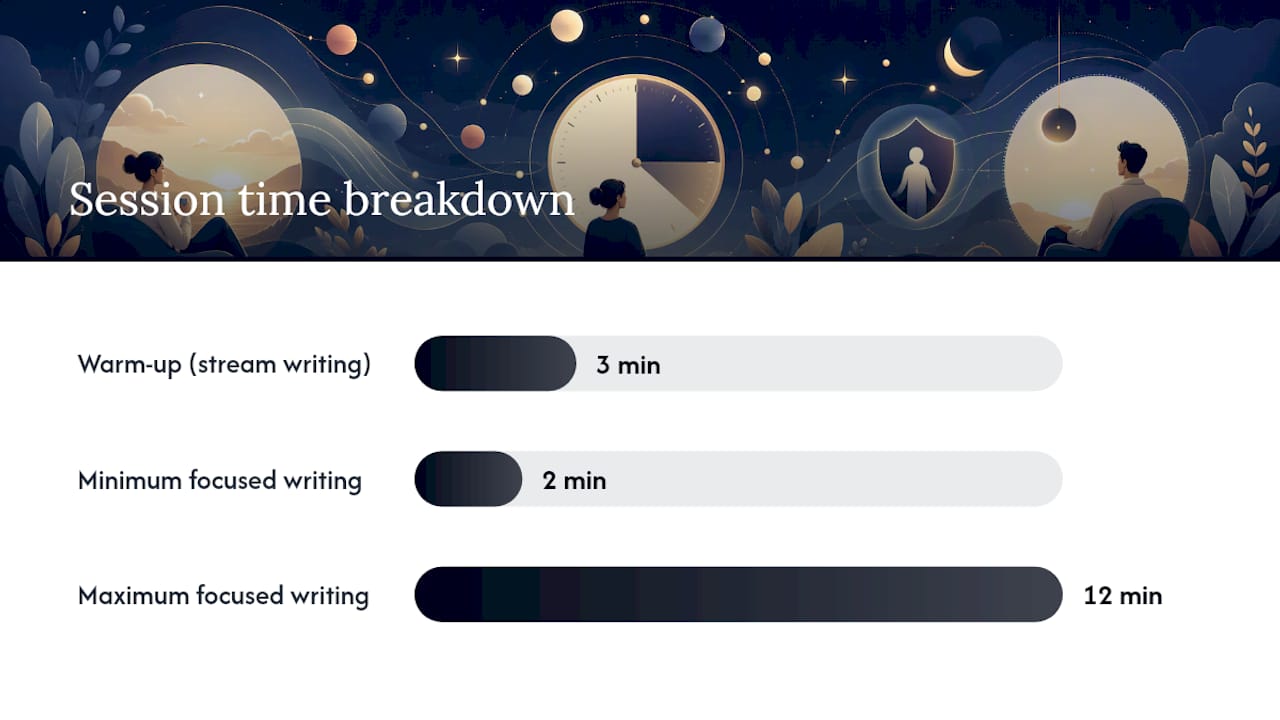
For the first three minutes, try stream-of-consciousness writing. Just let the pen move, even if the first lines are "I don't know what to write." That warm-up clears the mental static that keeps people staring at a blank page.
A tiny ritual makes the habit stick. Same chair, same mug, same five minutes after your coffee, whatever anchors it to something you already do. Research on self-reflection in professional settings links this kind of consistent practice to sharper communication and emotional intelligence over time, not from one big breakthrough entry but from small, repeated attention.
A few ground rules keep prompts useful instead of overwhelming:
- Choose one prompt per session. Answering three at once dilutes the writing and none of them get real attention.
- Write the ugly first draft. Grammar and neatness are not the point.
- Stop when the timer ends, even mid-thought. You can return to it tomorrow.
- If a prompt brings up something too big for the time you have, name it in one sentence and set it aside for a longer session.
Pro Tip: Keep a running list of "parking lot" topics, things a prompt surfaces that deserve more time than today's session allows. Revisit that list weekly instead of trying to solve everything in one sitting.
Self-Reflection Prompts By Theme
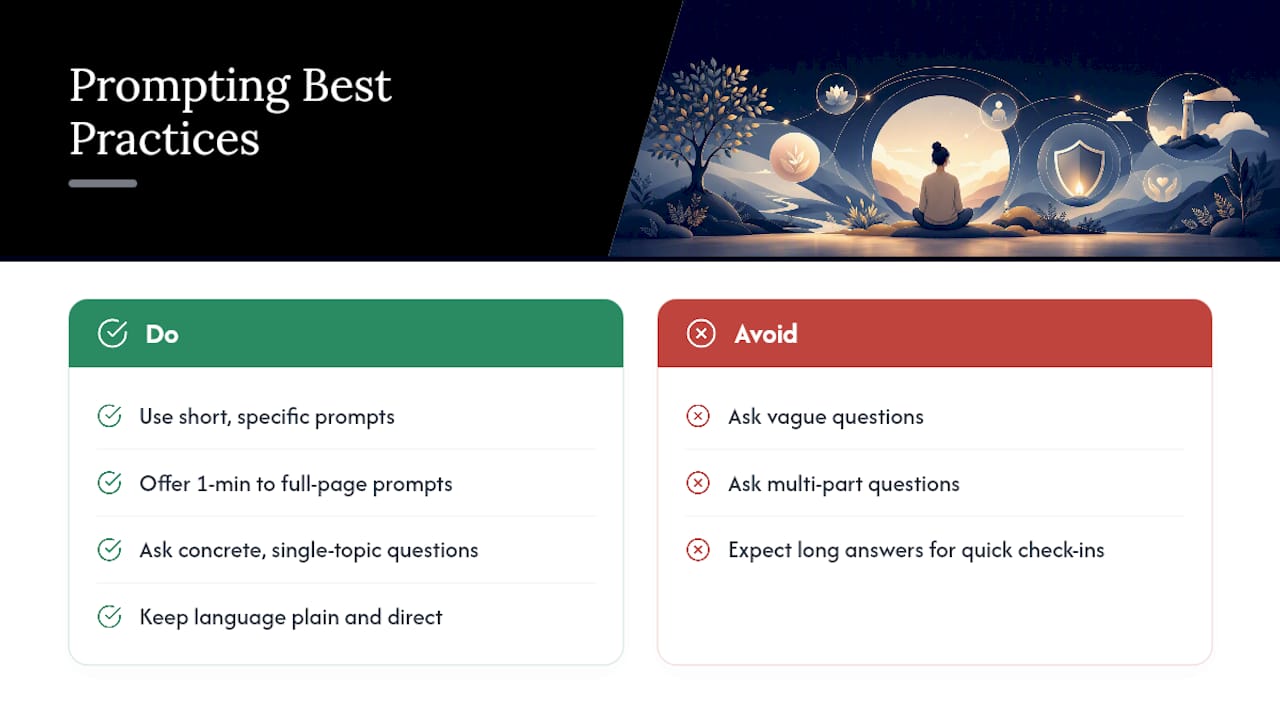
Short, specific prompts tend to get answered honestly. Vague ones ("How am I doing?") invite vague answers. The lists below run from one-minute check-ins to prompts worth a full page.
Daily check-in prompts (1 to 5 minutes)
- What emotion showed up most today, and where did I feel it in my body?
- What drained my energy in the last 24 hours?
- What gave me energy, even briefly?
- What's one thing I avoided today, and why?
- What did I need today that I didn't ask for?
- What's one word for how I feel right now?
- What am I looking forward to tomorrow?
- What would make tomorrow 10% easier?
These map closely to the kind of check-ins recommended for supporting mental health through journaling, which focuses on naming mood and identifying what quietly depletes you rather than just logging events.
Self-discovery prompts (values, identity, purpose)
- What did I do this month that felt fully "me"?
- What value do I compromise on most often, and why?
- When did I last feel proud, and what led to it?
- What belief about myself is outdated?
- What would I do differently if no one were watching?
- What role do I play in my family that I never chose?
- What's something I pretend not to care about?
- What does "success" mean to me right now, versus five years ago?
- What am I tolerating that I've stopped noticing?
- Who do I become when I'm stressed, and do I like that person?
- What's one label I've outgrown?
- If I trusted myself completely for one week, what would change?
Relationship prompts
- Who made me feel most understood this week?
- What boundary do I need to set, and with whom?
- Where am I giving more than I'm receiving?
- What conversation am I avoiding?
- Who do I need to forgive, even a little?
- What do I appreciate about a person I take for granted?
- How do I show love, and does it match how others receive it?
- What pattern from my family shows up in my closest relationships?
Career and goals prompts
- Does my current work reflect what I actually value?
- What task this week felt like a waste of my time?
- What skill am I avoiding because I'm not good at it yet?
- What would I pursue if money weren't a factor?
- Where am I playing it safe out of fear, not preference?
- What's one decision I've been postponing?
- What did I learn from a recent mistake at work?
- What does progress look like for me this quarter?
Gratitude prompts (deeper than a list)
- What's something ordinary I'd miss if it disappeared?
- Who taught me something I still use, and what was it?
- What hardship am I now grateful for, in hindsight?
- What part of my body am I grateful for today, and why?
- What's a small comfort I overlook daily?
- What did someone do for me recently that I haven't thanked them for?
- What season of my life, even a hard one, shaped who I am now?
- What's something about today specifically, not life in general, that I appreciate?
Gratitude prompts carry more than warm-fuzzy value. Regular practice has been linked to measurable drops in depressive symptoms when it moves past a quick list and into specifics like these.
Creativity prompts
- If today were a color, what would it be and why?
- What's a rule I'd break if there were no consequences?
- Describe your ideal ordinary day in detail.
- What childhood hobby have I abandoned that I miss?
- If I designed a room that felt exactly like "me," what's in it?
- What's a story I keep telling about myself that might not be true?
- What would I create if I had zero fear of judgment?
- What does my inner critic sound like, and what would I say back?
Memories and life-review prompts
- What moment from this year do I want to remember in five years?
- What did I let go of this year that I'm glad is gone?
- What surprised me most about myself this year?
- Who came into my life this year that changed something?
- What's a lesson I keep relearning?
- What would I tell myself at the start of this year?
- What chapter is closing, and what am I ready to open?
- What's one intention I want to carry into the next season?
Deeper Prompts for Emotional Processing (and When to Pause)
Some days call for more than a check-in. Prompts like "describe the feeling without naming it as good or bad," "trace back to when this pattern started," or "what's one small step I can take this week" help you process anxiety, grief, or transitions without spiraling into rumination.
That distinction matters. Structured reflection differs from unguided introspection: sitting with a feeling and asking what it's telling you is productive, while replaying the same worry for an hour without a next step tends to deepen overthinking and self-criticism instead of resolving anything.
A short safety checklist before you go deep:
- If a prompt brings up thoughts of self-harm, stop writing and reach out to a crisis line or a trusted person immediately.
- If the same painful memory surfaces across multiple sessions with no relief, that's a signal to bring it to a therapist, not just a journal.
- If writing about a topic leaves you more agitated than when you started, close the notebook and do something grounding instead, a walk, a call to a friend, slow breathing.
- Pair heavier prompts with lighter ones. A hard session on grief pairs well with a gratitude prompt the next day.
Journaling prompts aren't therapy, but structured check-ins can genuinely support mental health by helping you name what you're feeling and spot what's draining you, often the first step toward knowing when to ask for more support.
Why I Keep Coming Back to Prompts
I've relied on themed prompts for years, not because every entry produces a breakthrough, but because the steady, unglamorous repetition is what actually moves the needle. Some journal brands build their products around that same belief: reflection works best as ritual, not a one-time exercise. Many users of guided journals often mention how having the prompt already on the page removes the hardest part, deciding what to write about.
— Addie
Let a Guided Journal Do the Heavy Lifting
Picking a prompt every day works, but a lot of readers want the decision made for them. That's what a guided printable does: the structure is already on the page, so you open it and write instead of scrolling through prompt lists first.

Cosmicgoddessshop's Cosmic Reflections Journal pairs themed prompts with ritual-ready layouts built around lunar cycles, so your reflection habit has a rhythm instead of relying on willpower alone. If your reflection tends toward identity and personal growth, the Soul Alchemy Printable Journal leans into that territory, and for anyone ready to work with harder emotional material safely, the Shadow Work Journal offers structured pages built for exactly that kind of depth.
When you're comparing printable journals, look for genuine prompt variety across themes, not just a dozen variations on the same question, plus compatibility with GoodNotes and Notability if you journal digitally, or clean print layouts if you prefer pen and paper. Grab the Cosmic Reflections Journal as an instant download and start your next session with a page already waiting for you.
Sources
- Don’t Underestimate the Power of Self-Reflection
- Introspection vs. self-reflection: How to reflect without overthinking
- 10 journaling prompts for better mental health
FAQ
What are the 5 R's of self-reflection?
The 5 R's, Reporting, Responding, Relating, Reasoning, and Reconstructing, come from a structured reflection framework that walks you from describing an experience to reworking your understanding of it. It's especially useful for longer, deeper journaling sessions rather than quick daily check-ins.
What are some good reflection prompts?
Strong prompts are specific and answerable in one sitting, like "What drained my energy today?" or "What value do I compromise on most often?" rather than broad questions like "How am I doing in life?"
What are self-reflection prompts?
Self-reflection prompts are focused questions designed to guide introspection about your emotions, choices, relationships, or goals, turning a blank journal page into a specific, answerable starting point.
How many self-reflection prompts should I use per session?
One. Answering multiple prompts in a single sitting usually means none of them get the attention needed to surface something useful.
Can journaling prompts replace therapy?
No. Prompts can help you name emotions and spot patterns, but unguided introspection has limits, and recurring distress deserves a licensed professional, not just a notebook.