Here are ready-to-use manifestation journal prompts, organized by skill level, plus the exact session recipe to use them now. Pick one prompt from the beginner list below, set a timer for 5 to 10 minutes, and write in present tense as if what you want has already happened. The rest of this guide gives you categorized prompts, three session templates, and the methods (scripting, the 3-3-3, the 369) that turn a blank page into a repeatable practice.
TL;DR:
- Manifestation journal prompts should be matched to your skill level, with beginners focusing on clarity and gratitude, while advanced practitioners work on identity.
- Use methods like scripting, 3-3-3, or 369 to reinforce your goals through sensory detail, repetition, and emotional honesty.
- Spend three minutes resetting your state before writing, and answer prompts with depth, honesty, and specific sensory details to deepen your practice.
- A guided journal with prompts and tracking sections can improve consistency and help you monitor progress over 21 days or more.
- Progression depends on familiarity with the process, moving from simple wish-list style entries to identity-level work that reprograms your self-image.
Table of Contents
- What Are Manifestation Journal Prompts and How Do You Use Them?
- Beginner Manifestation Writing Prompts to Start Your Practice
- Intermediate Prompts for Emotional Specificity and Naming Blocks
- Advanced Prompts for Identity Work and Future-Memory Scripting
- Session Templates: Quick, Focused, and 21-Day Install
- Matching Prompts to Your Practice Level
- A Note on Messy Practice and Realistic Timelines
- Why a Guided Printable Journal Makes This Practice Easier to Keep
- Sources
- FAQ
What Are Manifestation Journal Prompts and How Do You Use Them?
Manifestation journal prompts are guided questions or sentence starters designed to move you from vague wanting into specific, felt experience on the page. The practice draws on techniques with names you may already recognize, scripting, the 3-3-3 method, the 369 method, but the mechanism behind all of them is the same: repetition and sensory detail help rehearse a future outcome as if it's already familiar.
Before you write, spend three minutes resetting your state. Take five slow breaths, plant your feet, and name one thing you're already grateful for. This isn't fluff. A calm nervous system writes with more sensory detail than a rushed one, and detail is what makes a prompt work.
From there, choose your method:
- Scripting means writing a full scene in present tense, as though you're a character living the outcome right now. You describe what you see, hear, and feel, not what you hope for.
- The 3-3-3 method has you write three things you're grateful for, three things you're excited to manifest, and three actions you'll take that day, giving you a fast structure when you don't have time for a full scripted scene.
- The 369 method asks you to write your goal or affirmation three times in the morning, six times midday, and nine times at night, using repetition to reinforce a single intention across one day.
- Future-self letters put you in the voice of the person who's already achieved the goal, writing back to your current self with advice and reassurance.
For a session recipe: pick one to three prompts, give each one 5 to 10 minutes, and let the writing get messier and more specific with each layer. Answer the prompt, read your answer back, then write a second, deeper layer from the identity voice, the version of you who has already arrived.
Pro Tip: After each session, circle the one sentence that felt the most emotionally true. That sentence often makes the best affirmation to carry with you during the day.
Beginner Manifestation Writing Prompts to Start Your Practice
If you're new to this, don't try to write a perfect scene on day one. Start small, pick one or two prompts per session, and let the practice build naturally. These twenty beginner prompts fall into five categories: clarity, gratitude, release, embodiment, and aligned action. Clarity prompts help you name what you actually want instead of what you think you should want.
- What do I want more of in my life right now, and why?
- If I could wave a wand and change one thing today, what would it be?
- What does "success" mean to me personally, not to anyone else?
- What have I been afraid to admit I want?
Gratitude prompts train your attention toward what's already working, which studies on positive psychology tie to better mood and follow-through.
- What are three small things I'm grateful for today?
- Who in my life makes me feel supported, and why?
- What's something about my body I appreciate right now?
- What past win am I proud of but rarely mention?
Release prompts clear emotional clutter before you write toward something new.
- What belief about money (or love, or success) am I ready to let go of?
- What am I holding onto that no longer serves me?
- What would it feel like to forgive myself for a recent mistake?
- What fear is loudest right now, and what would I say to it?
Embodiment prompts ask you to feel the goal, not just describe it.
- What does a day in my ideal life feel like, physically?
- How does my future self walk into a room?
- What would I wear, eat, or say differently if I already had this?
- What emotion do I want to feel more of this week?
Aligned action prompts turn feeling into movement.
- What's one small step I can take today toward my goal?
- What have I been avoiding that would actually move me forward?
- Who could I reach out to this week to support my goal?
- What would the version of me who already has this do today?
Intermediate Prompts for Emotional Specificity and Naming Blocks
Once the basics feel familiar, intermediate work asks you to get more specific and more honest, especially about what's blocking you. These prompts push past surface answers into the sensory and emotional detail that makes a prompt actually land, and toward naming the limiting beliefs sitting underneath your goals.
- Describe the exact moment you'll know your goal has happened. What do you see first?
- What sound is in the room when this goal becomes real?
- What does your body feel like in that moment: tense, light, warm?
- What's the specific belief that says this isn't possible for you?
- Where in your life did you first learn that belief?
- What evidence, however small, contradicts that belief right now?
- If your block had a voice, what would it say?
- What would you need to believe about yourself to make this easy?
- Write one paragraph as if you're already living the outcome. Use only present tense.
- What smells, textures, or sounds surround you in that scripted scene?
- Who is with you when this goal happens, and what are they saying?
- What did you have to release to get here?
- What's one thing your past self would be shocked to see you doing now?
- What does "enough" feel like in this area of your life?
- What conversation are you avoiding that relates to this goal?
- What would you do differently this week if you fully believed this was coming?
- What's the smallest possible sign that would tell you're on track?
- Where do you feel resistance in your body when you write about this goal?
- What identity do you need to practice being, not just achieving?
- Rewrite one limiting sentence from earlier in your journal into an empowered one.
Repeat any of these until the answer feels true in your body, not just correct on paper. That felt shift is the signal to move on.
Advanced Prompts for Identity Work and Future-Memory Scripting
Advanced prompts stop asking what you want and start rehearsing who you're becoming. This is identity-level work: the same prompt, written across weeks, until the identity feels less like a performance and more like memory.
- Write a full page as your future self describing an ordinary Tuesday after the goal has happened.
- What do you no longer worry about, now that this is your reality?
- Describe your morning routine as the person who has already achieved this.
- What does your future self want you to stop apologizing for?
- Write a letter from your future self to your current self, dated one year from today.
- What advice does that future self give about the exact fear you're feeling right now?
- What has become boring or unremarkable about this achievement?
- Describe the room you're in, the future memory, in full sensory detail.
- What does your future self's handwriting, voice, or posture feel like?
- What relationships have shifted because you became this person?
- What did you have to stop doing to become this version of yourself?
- Write the exact words someone says to you that confirm this is real.
- What's a small, mundane detail (a receipt, a smell, a sound) that proves this future is lived-in, not imagined?
- What identity label do you now claim without hesitation?
- What would this version of you never tolerate anymore?
- Describe how you handle a setback as this future self.
- What does financial (or creative, or relational) ease feel like day to day?
- What are you most grateful for in this future, that you don't have yet?
- Write the internal monologue of this future self on an average morning.
- What do you want to remember about the process of becoming this person?
For identity-level prompts, using the same one for 21 to 33 days compounds the installation effect, while block-clearing prompts work better when you rotate them until the block actually shifts.
Pro Tip: This kind of work can surface real emotion. If a prompt brings up grief or anxiety that feels bigger than the page, close the journal, take a walk, and return to lighter prompts before circling back.
Session Templates: Quick, Focused, and 21-Day Install
You don't need an hour to make this practice work. What matters is matching the template to the time and depth you actually have that day.
The 5-minute quick reset: Pick one beginner or gratitude prompt. Write without editing. Circle one sentence that feels true. Use it as your affirmation for the day.
The 20-minute focused session: Choose one intermediate or advanced prompt. Do the layered write: answer once, read it back, then write a second, deeper answer from the identity voice. Close with one inspired action you'll take within 24 hours.
The 21-day identity install: Pick a single advanced identity prompt and write it daily for three weeks, morning sessions tend to produce stronger installation effects since your mind is closer to the theta-alpha border right after waking. Track three things across the 21 days:
- The emotionally resonant sentence you circled that day
- Any inspired action you took, however small
- Small pieces of evidence you noticed that the goal is moving closer
If a prompt starts to feel forced or stale, that's information, not failure. Skip it and choose a different one from the same category rather than forcing an answer that isn't honest. A prompt that feels like homework has stopped doing its job.
Matching Prompts to Your Practice Level
Most people move through three loose stages with manifestation journaling, and knowing which one you're in helps you choose prompts that actually challenge you instead of ones that feel too easy or too far out of reach.
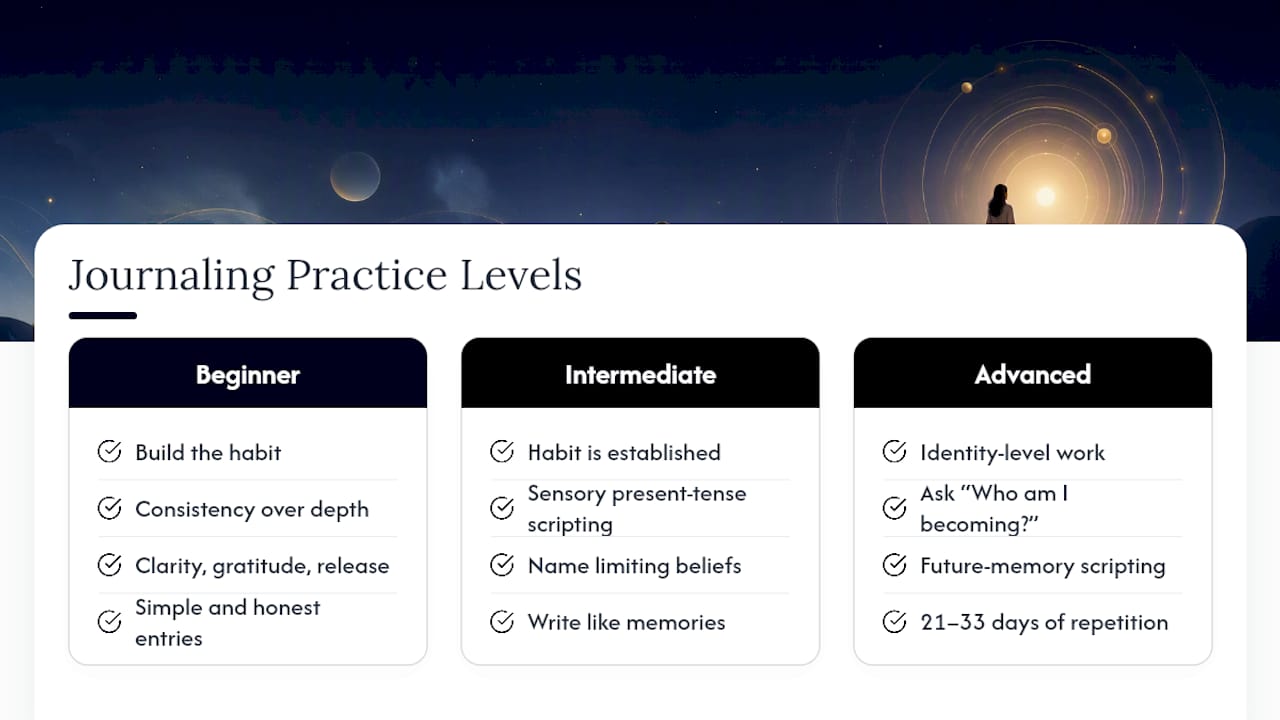
Beginners are still building the habit itself. The goal at this stage isn't depth, it's consistency and comfort with the format. Stick to clarity, gratitude, and release prompts, and don't worry if your entries feel simple. Simple and honest beats elaborate and forced every time.
Intermediate practitioners have the habit down and are ready to get specific. This is where sensory detail, present-tense scripting, and naming limiting beliefs start to matter. If your entries still read like a wish list ("I want a better job"), you're likely still in beginner territory even if you've been journaling for months. The intermediate shift happens when entries start reading like memories instead of requests.
Advanced practitioners work at the identity level. The prompts stop asking "what do I want" and start asking "who am I becoming." This stage rewards patience: writing the same future-memory prompt for 21 to 33 days straight feels repetitive at first, then starts to feel like recall rather than invention.
You can move between levels depending on the goal. A person can write advanced identity prompts about their career while using beginner gratitude prompts for their health. Skill level isn't a fixed rank, it's matched to how clear and practiced you are in that specific area of your life.
A Note on Messy Practice and Realistic Timelines
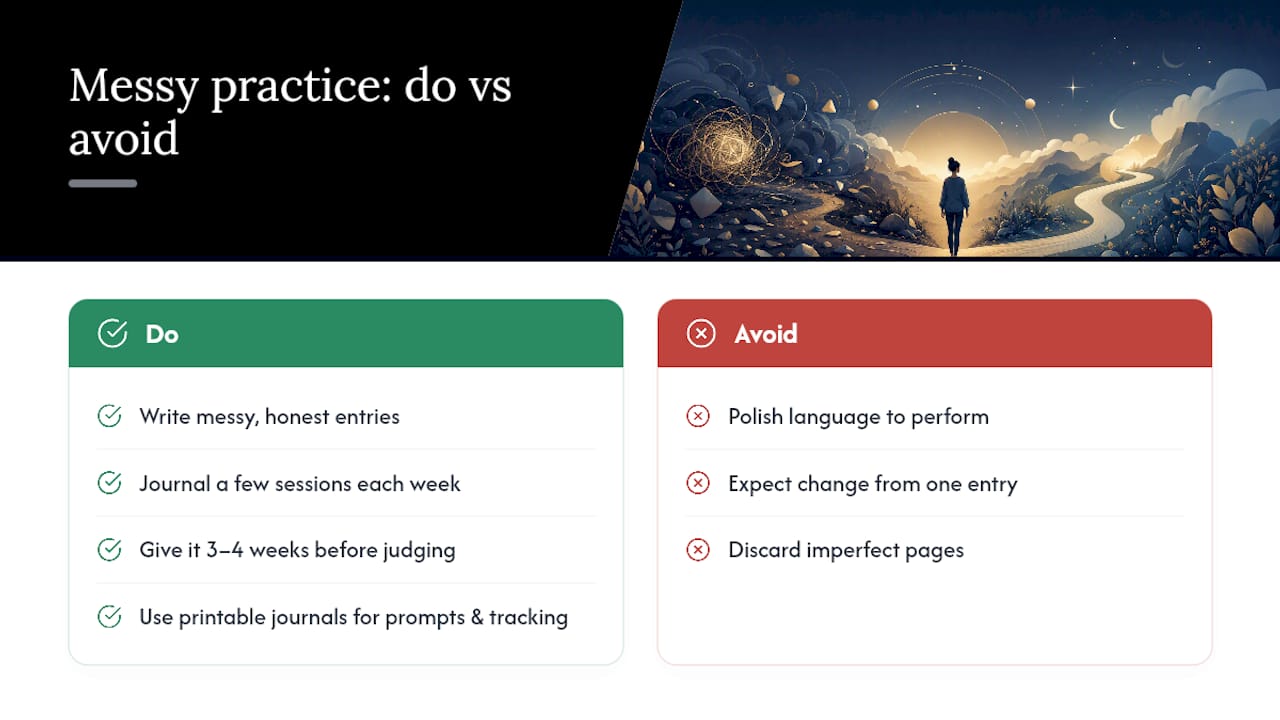
Your journal doesn't need to read well. Some of the most useful entries I've seen described in this space are half-finished sentences, crossed-out words, and one honest line buried in three paragraphs of rambling. Forcing polished, ideal language onto the page usually means you're performing the practice instead of doing it.
Give it three to four weeks of a few sessions a week before expecting a felt shift, not a single perfect entry. Printable journals build in guided prompt pages and tracking space precisely because structure helps on the days motivation doesn't show up.
— Addie
Why a Guided Printable Journal Makes This Practice Easier to Keep
A blank page is the biggest obstacle to consistency, and that's exactly what a structured printable solves. Cosmicgoddessshop's Celestial Rose Manifestation Journal is built around the same categories covered above: gratitude, release, embodiment, and identity work, with guided prompt pages and tracking sections so you're not starting from scratch every session.

The layout supports all three templates from this guide. Use the quick pages for a 5-minute reset, the deeper spreads for a focused 20-minute session, and the repeatable tracking pages for a 21-day identity install where you log your resonant sentence, inspired actions, and evidence as you go. Each journal is an instant PDF download, compatible with popular note-taking apps or ready to print at home, with celestial-themed design that makes the ritual feel intentional rather than clinical. If you'd rather build your practice around identity and archetype work specifically, the Goddess Archetype Journal offers a more focused structure for that deeper stage. Browse the Cosmic Reflections Journal if tracking and reflection pages matter most to your practice, and pick the format that fits how you actually plan to journal.
Sources
FAQ
What is the 3-3-3 journal method?
The 3-3-3 method has you write three things you're grateful for, three things you're excited to manifest, and three actions you'll take that day, giving you a fast, structured entry when you're short on time.
What do I write in my manifestation journal?
Write present-tense scenes, gratitude lists, named blocks or limiting beliefs, and future-self letters, choosing one to three prompts per session rather than trying to cover everything at once.
What is the 3-6-9 journaling method?
The 369 method has you write your goal or affirmation three times in the morning, six times midday, and nine times at night, using repetition throughout a single day to reinforce one specific intention.
What is the best journal for manifesting?
The best journal pairs guided prompts with tracking pages so you can log resonant sentences and evidence over time; Cosmicgoddessshop's Celestial Rose Manifestation Journal is built around exactly that structure.